According to the constitution of Nepal, Nepal is an independent, indivisible, sovereign, secular, inclusive, “Democratic”, “Socialism-oriented”, “Federal democratic republican State”. These constitutional descriptors are not symbolic labels; they outline how political power is structured, exercised, and legitimized.
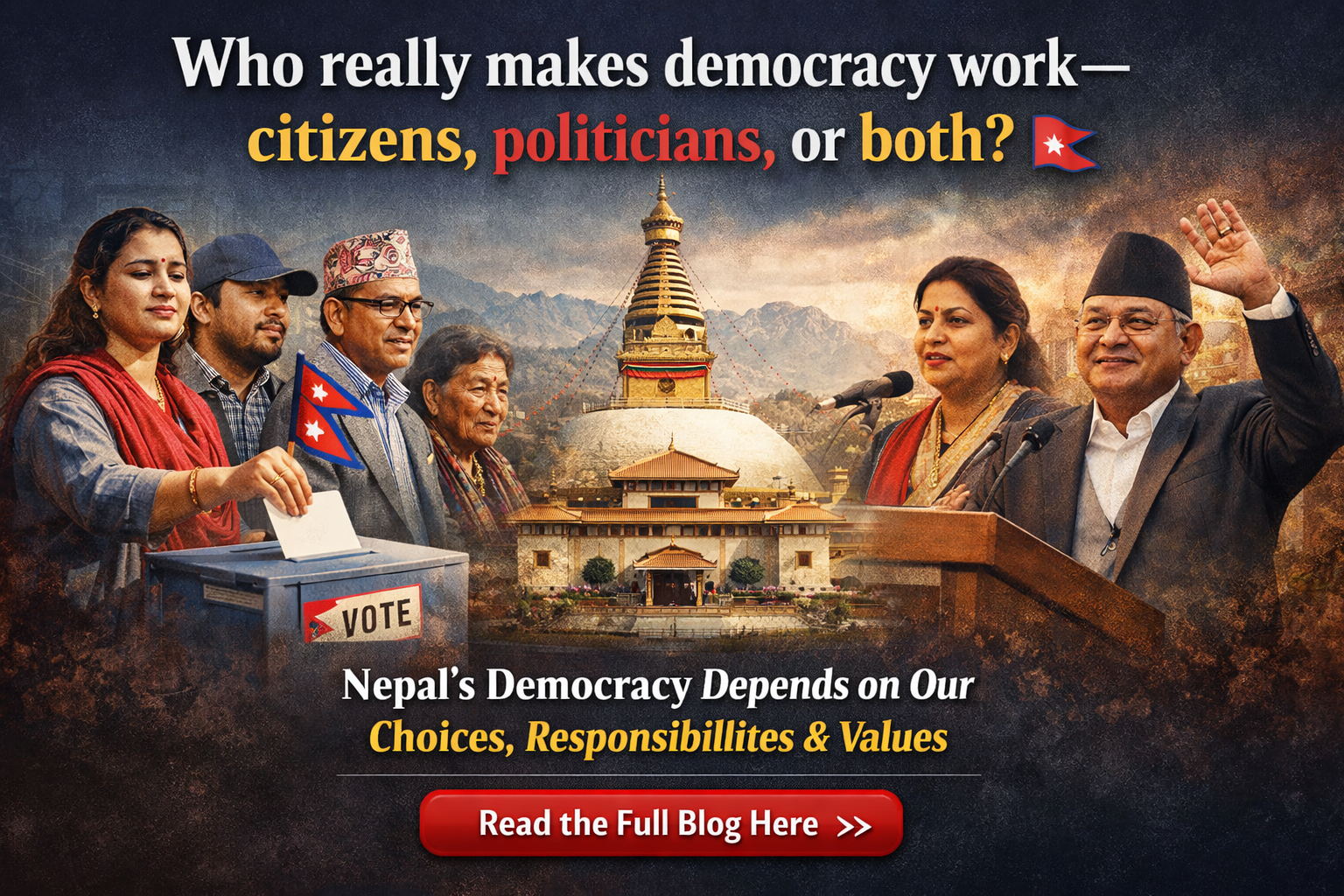
What does it mean, then?
Democratic = Political power is held by the people, who exercise state power through electoral representation, participation, and constitutional institutions.
Socialism-oriented = This does not state it is Socialist state but aims to move towards socialist principles through democratic means. The state should aim to reduce inequality and promote social welfare.
Federal = decentralized governance structure, meaning power is divided between the central government and regional governments (three layer of governance; the central government, the provincial governments, and the local governments).
republican = Nepal is a republic, meaning it is not a monarchy. The head of state is the President, who is elected by the people or representative of the people.
Federal democratic republican state = Nepal should operates as a republic grounded in democratic legitimacy and structured through a federal system of power-sharing across multiple tiers of government.
From this we can conclude that “Elections” are the primary constitutional mechanism for citizens to exercise their political power. To choose their representatives/Leaders, who will rule by law and constitutions, if needed they will change the law following the law to fullfill the needs of the people.
Together, this framework establishes elections as the primary constitutional mechanism through which citizens transfer governing authority to representatives. Elections are not the entirety of democracy—but they are its most visible moment of accountability and consent.
This raises three foundational Civic Questions:
- What kind of citizens we should be?
- Who should serve as the representative (politician/Leader/Representative)?
- How should people evaluate them?
Citizens: The Foundation of Democracy
We often talk about the structures of democracy—votes, laws, institutions. But we rarely ask the hardest, most important question: what kind of people does it need to run? This question is so fundamental and challenging that the entire history of democracy is an attempt to answer it. Democracy isn’t a finished product you install; it’s a continuous practice. It depends on the character and conduct of its citizens.
Think of it instead as a garden (King Prithvi Narayan Shah compared Nepal to a garden of different flowers). For it to thrive, it needs citizens with Civic Virtues, who can look beyond themselves to the General Will. It needs people who show up, participate, and agree to be bound by the rules—both the Constitution and the decisions made by their representatives. It needs communities built on association, self-restraint, and local responsibility. Most of all, it needs an education that cultivates not just knowledge, but moral wisdom. That’s the soil from which real democracy grows.
Success of vibrant democratic republic depends on the what kind of citizens we become. If we the people failed we backslides towards suffocating decay as we witnessed now, withered institutions. Corruption will grow, state will be ruled by the few, state and law will be used to opress us. It tries to establish virtue is naivete, breeding more cynicism and withdrawal, which in turn enables even worse governance.
Politicians: Trustees, Not Rulers
Politics should not be an arena of power accumulation but of public stewardship. Based on constitution of Nepal, politician is not a ruler but a trustee of the people.
| Ideal Leader | Realistic Outcome |
|---|---|
| Competent, virtuous, and accountable. | Charismatic, media-savvy, ambitious types rise. |
| Wise, able to judge and moderate situations. | Machiavellian people with skill and boldness tend to succeed. |
| Conscience and intellectually independent. | Voters rely on heuristics, identity, or emotions. |
Ideally, our leaders should be competent, virtuas, and accountable. Politicians should be wise, able to judge and moderate the situations, conscience and intellectually independent. In reality, charismatic, media savvy, ambitious types people rise to the position, rather than moral virtue, Machiavellion people with skill and boldness tend to succed. Voters rely on heuristics, identity, or emotions. For example, people will vote simply because a person they trust endorsed them, people of their religion/race/geography, or based on hopes/fear/anger. Most of them will not examine with rational thinking and meritocracy.
I believe, we should not elect who are corrupt and criminals these are the first layer of decision making. In another layer we should judge their morality, morally fluid or corrupt people are as dangerous as the criminals. They will hold power in our behalf and universally power tend to corrupt. Leaders should be capable of thinking independently, competent, should be able to work with different fraction of people, who should think for the people above self interst, who should respect laws and accountable. Beyond legality, moral judgment also matters, because power exercised without ethical restraint can damage institutions and public trust.
Evaluating Representatives: The Voter’s Responsibility
Elections are the backbone of representative democracy our way to give consent and withdraw it peacefully. But Nepal’s record shows problems: spectacle beats substance, money and muscle matter too much, short-term populism wins, coalitions form and break for power not policy.
We should evaluate on:
| Criterion | Key Questions |
|---|---|
| Track Record | Past actions, not just promises. Clean? Delivered results? Respect towards people, institutions and laws? |
| Character & Judgement | Do your leader show independence, moderation, ability to handle crises without panic or vendetta? Emotional stability? |
| Competence | Understanding of how state works, how simple economy works, how to include all peoples and international geopolitics. |
| Accountability | Willing to answer, face scrutiny and accept constitutional limits. |
When elections are driven only by slogans, short-term promises, or identity loyalties, democratic quality declines. When voters prioritize performance and integrity, governance improves.
A Shared Constitutional Responsibility
The preservation of Nepal’s constitutional democracy is not solely the responsibility of politicians or institutions. It is a shared civic duty of all citizens.
Strong leaders emerge from strong civic cultures. Accountable governance grows where citizens remain vigilant, informed, and engaged. In this sense, democracy is not a finished system but a continuous national practice — one that must be nurtured across generations.
The Constitution provides the framework. Its success depends on the people who operate within it — both those who govern and those who choose them.
Democracies rarely fail only because of bad leaders; they falter when civic responsibility erodes along side political accountability.